
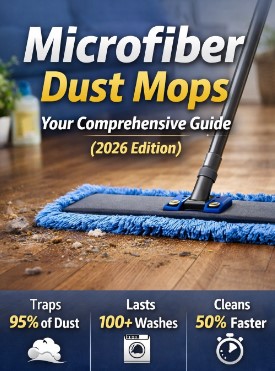
Microfiber dust mops first hit the scene in the late 1990s and early 2000s. Yep, they’ve been around for quite a while. They started in commercial and healthcare cleaning before becoming part of everyday home cleaning.
But are they really as good as they sound or just another overhyped trend?
Whether you’re here to learn, compare options, or are ready to buy, this guide is for you. We’ll explain why they’re so popular, which options are worth your money, and how to choose the perfect fit.
Let’s get into it.
The Basics – What Is a Microfiber Dust Mop?
A microfiber dust mop is a highly efficient cleaning tool made for hard surfaces. It uses ultra-fine synthetic fibers, which are typically a combination of polyamide and polyester material. The fibers create a static charge that attracts fine dust and hair instead of pushing it around.
Microfiber mops are best for hardwood, laminate, tile, vinyl, and stone. They’re quick, gentle, and effective, making cleaning feel almost effortless.
Microfiber Dust Mops vs Alternatives: Why Microfiber Wins
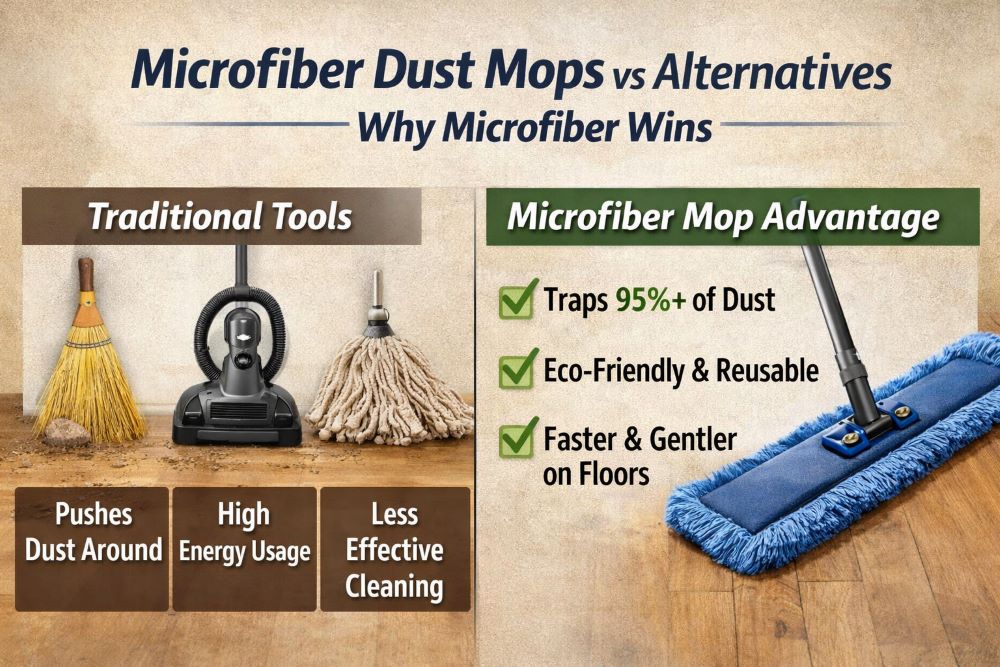
Microfiber outperforms traditional cleaning tools, such as brooms, vacuums, and even cotton dust mops in several ways.
The Mops Trap Up to 95%+ of Microbes
Microfiber mops trap fine dust instead of sending it into the air like traditional brooms. As explained, they work through electrostatic attraction and mechanical filtration to lift and lock particles away from the surface.
As the mop moves across the floor, the synthetic fibers rub together, generating a static charge. This static is like a magnet. It attracts negatively charged dirt, dust, and pet allergens to the positively charged fibers—up to a 95–99% level. Traditional cotton mops normally do around 67%. That gap is significant.
Faster and Gentler on Hard Floors
When you want to clean quickly, microfiber dust mops are a game-changer. Studies show that microfiber flat mops can increase surface contact coverage by up to 40% more than string mops. And thanks to their wide head, a single pass means you’re done—no backtracking or wrestling buckets.
Unlike a vacuum cleaner, you can cover more ground fast because the mop grabs dirt immediately. And since you’re not using water, you don’t have to wait before you can walk on the floor—no drying time required.
And then—the gentle touch. These fibers are soft and smooth. They lift debris without scratching your precious floors. No harsh scrubbing, no water overload. Just a quiet, controlled cleanup.
Microfiber Mops Are Eco-Friendly
Let’s start with waste. Many traditional mops use disposable pads, which equals endless trash. For microfiber, it’s mostly wash, reuse, and repeat. One pad replaces hundreds. That makes these mops a cost-effective choice over time.
Then think of water and buckets sloshing everywhere. Microfiber needs barely any; less water used means less water wasted. Also, the tiny fibers do the heavy lifting alone— they trap dirt without harsh cleaners. A mild detergent cleaner is all you need. That means fewer chemicals down your drain, fewer fumes in your home.
Energy use drops, too, thanks to fewer supplies and replacements needed. That reduced production demand adds up faster than you’d expect.
So the story shifts. You’re not just cleaning your floors. You’re cutting waste and skipping chemicals. Feels good, doesn’t it?
Related: The Best Floor Cleaner for Wood — Here’s What Might Save Your Floors (and Your Sanity)
A Quick Look at Microfiber Dust Mops vs Alternatives
I’ve put this into a table so you can see the differences at a glance.
| Features / Factor | Microfiber Dust Mop | Traditional Broom | Vacuum Cleaner | Cotton Dust Mop |
| Dust & Allergen Removal | Up to 95-99%, traps dust and microbes using electrostatic attraction | Pushes dust around; releases particles into air | Moderate; can stir dust if not HEPA-filtered | Around 60-70%; traps less dust than microfiber |
| Surface Contact & Efficiency | Wide head, flat design; covers up to 40% more surface per pass | Narrow, uneven contact; multiple passes needed | Requires multiple passes; slower on corners | Limited contact; may need repeated passes |
| Floor Safety / Gentleness | Soft, smooth fibers; gentle on hardwood, tile, laminate, and stone | Hard bristles can scratch floors | For the most part, vacuums are safe on floors | In some cases, fibers can be abrasive when wet |
| Eco-Friendliness | Reusable pads, minimal water and cleaning agents | Reusable broom reduces waste; no detergent needed | Electricity-intensive; bags/filters generate waste | Reusable, but less efficient than microfiber |
| Speed & Convenience | Fast, glides easily; fewer passes; works dry or slightly damp | Slow, labor-intensive | Moderate; limited maneuverability in tight corners | Moderate; requires more effort than microfiber |
Cost vs Value Analysis
Microfiber dust mops are a high-value proposition compared to traditional mops. Though they cost more upfront, the math quickly swings in your favor.
-
- Facilities using disposable mop pads can spend up to ~3x more over time compared to reusable systems.
-
- Households using disposables spend about $190 annually on refills alone.
-
- Reusable microfiber can last 17–113 washes, spreading the cost dramatically.
So yes, you pay more today, but you can cut long-term cleaning costs by as much as 50-70%, depending on usage.
Also, since the mops are lightweight, they glide and clean in fewer passes. Studies show microfiber systems can reduce cleaning time by up to 30–50% in commercial settings. Less time per room equals hours saved.
Maintenance is simple since the pads are machine washable and can last over 100 wash cycles. They also dry faster—often within 1–2 hours, speeding up turnaround. And durability seals it. High-quality microfiber maintains performance across all those washes, unlike cotton, which degrades much faster.
So the result is clear.
Less time—cut by up to half.
Longer life—more than a hundred uses; money saved.
That’s not an upgrade; that’s a system reset.
Summary of the Cost vs Value Analysis
| Factor | Microfiber Dust Mop | Traditional / Disposable Mops |
| Upfront Cost | Higher initial investment | Low initial cost |
| Pad Longevity | 17-113 washes; high-quality pads last 100+ cycles | Disposable pads; frequent replacements |
| Long-Term Cost | Can cut cleaning costs by 50-70% over time | Spend more on refills; households ~$190/year |
| Labor / Efficiency | Lightweight, glides easily; reduces cleaning time by 30-50% in commercial settings | Slower, heavier and less efficient |
| Maintenance | Machine-washable pads; quick drying (1-2-hours) | Frequent replacement; slower turnaround |
| Durability / Performance | Maintains performance across washes | Cotton pads degrade faster, loose effectiveness |
Types of Microfiber Dust Mops – Choose Your Best Fit
Not all microfiber mops are built the same. Each type is meant to solve a different cleaning problem. Therefore, it’s important to choose what fits your needs.
1. Standard Flat Microfiber Dust Mops (Best for Homes)
Standard flat microfiber mops are the everyday heroes.
They’re slim, lightweight, and easy to maneuver. Ideal for daily cleaning in small to medium spaces, especially homes with pets and hair. They slide under furniture and hug edges effortlessly.
The following are some top-rated microfiber flat mops:
Quick note: As an Amazon Associate, we earn from qualifying purchases made through links in this content at no extra cost to you. This means we may receive a small commission when you click on product links and finalize a purchase—helps support this site.
BPAWA Flat Floor Mop
-
- Comes with 4 Washable Pads
-
- 59″ adjustable metal handle
-
- 360°swivel flat mop head to reach most hard-to-access areas
Bona Premium Sweep & Clean Mop
-
- Patented dual-zone design; the cleaning pad lifts and removes stubborn dirt and grime
- 3-in-1 floor cleaning tool; sweep, clean, and polish
- 34″ to 52″ telescopic adjustable pole
Conliwell Flat Mop
-
- Stainless steel handle
- 4 reusable washable mop pads
- Wet and dust mopping
2. Industrial / Commercial Wide Mops (Best for Time-Conscious Cleaning)
Now we scale up.
These come with wider heads, often 24 to 36 inches. They’re built for speed and coverage. A single pass cleans large floor areas. Although you can still use these mops at home, they’re best-suited for large spaces with high traffic, such as hotels, warehouses, hospitals, and shopping malls.
A few top-rated units:
MASTERTOP Commercial 36″ Large Dust Mop
-
- 3 reusable microfiber pads
- 62″ adjustable handle; easy to maneuver in tight spaces
- Head rotates 360° to reach every corner and crevice effortlessly
- Sturdy construction; built to last
CLEANHOME 36″ Commercial Dust Mop
-
- 39″ X 8.5″ microfiber mop pad for quick, large-area cleaning
- 59″ extendable, rust-proof, and lightweight handle
- 360-degree rotating mop for easy maneuverability in hard-to-reach places
MR.SIGA Professional Microfiber Mop
-
- 3 reusable flat mop pads ideal for all kinds of floors; dual-action; wet/dry mopping
- 360-degree maneuverable swivel head to easily reach those hard-to-access spots 15″ x 5″ wide surface mop pad for wide coverage and quick cleanups
- Stainless steel telescopic handle; no need to bend down
3. Spray-Compatible Microfiber Mops (Best for Household / Commercial Setups)
Convenience meets control.
These mops come with a built-in spray system. That means no bucket, no trips back and forth. Just spray and go. They prevent over-wetting, which is critical for wood and laminate floors. You can use these mops for quick cleanups or spot cleaning in apartments and small homes.
Here are a few examples we recommend:
EXEGO Microfiber Spray Mop
-
- 360° swivel head easily reaches into tight spaces, including under furniture
- 3 washable reusable pads; save money in the long run.
- Refillable bottle; you can add your favorite cleaning solution or water
See the current price on Amazon➡
MEXERRIS Spray Wet Microfiber Dust Mop
-
- Extra-thick mop replacement pads to last 100+ uses
- 3 reusable mop pads so you always have a spare one when one pad gets dirty
- Lightweight; clean with minimum effort
- 360-degree rotating spray mops reach every corner and crevice with ease
O-Cedar ProMist MAX
-
- Dual-sided microfiber mop; flip and clean floors fast without having to switch the mop pad
- Refillable, one-touch release bottle; add your favorite cleaner or water as needed
- Wet and dry function for versatile cleaning
By now, you know that buying a microfiber dust mop isn’t just “grab any mop.” The table below breaks down the most important differences to help you choose your perfect fit.
| Type of Microfiber Mop | Best Use Case | Head Width | Cleaning Style | Special Features | Cost Range |
| Standard Flat Microfiber Mop | Homes, apartments, small-medium spaces | 12-18 inches | Dry dusting & Wet mopping | Lightweight, 360° swivel, easy under furniture | Low-Medium |
| Industrial / Commercial Wide Mop | Large, high-traffic areas (hotels, warehouses, hospitals) | 24-36 inches | Large-area dusting | Built for speed & durability, 360° swivel | Medium-High |
| Spray-Compatible Microfiber Mop | Quick cleanups, spot cleaning, household / commercial use | 12-16 inches | Wet or dry with integrated spray | Built-in spray bottle, dual-sided pads, 360° swivel | Medium |
Read also: Best Robot Mop for Hardwood Floors – Effortless Shine, Every Time
Expert Tips for Effective Microfiber Dust Mopping Results
Cleaning with a microfiber dust mop requires strategy if you want to achieve the best results every single time. Consider these few tips and tricks.
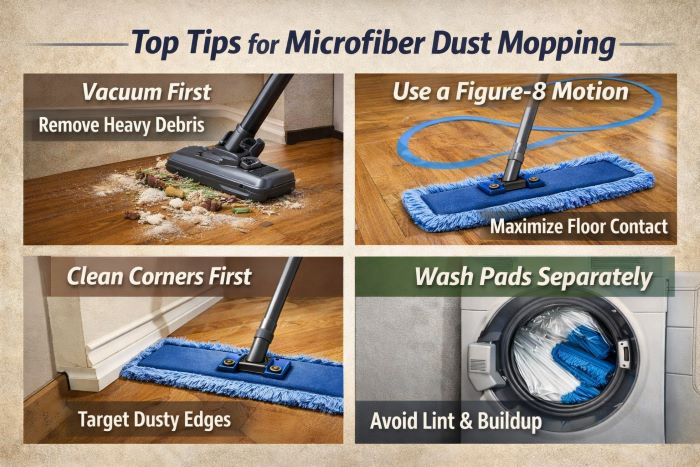
Vacuum Heavy Soiled Spaces First – Teamwork Wins
For heavily soiled floors, start with vacuuming whenever possible. It drastically reduces your cleaning time. Your microfiber is great at dust and fine particles. However, larger pebbles and crumbs can get pushed around. You end up doing extra passes.
But when you vacuum first, you eliminate the “heavy hitters” so the mop can focus on the fine stuff. We see it like this: vacuum clears the battlefield so that the mop swoops in for precision cleanup.
The Figure-Eight Motion – Glide Like a Pro
Instead of pushing straight lines, use a figure-eight or “lazy infinity” motion. That maximizes fiber contact with the floor. As a result, more dust gets lifted, and there’s less risk of streaks.
Handle the Corners First
Corners are dust magnets. Always start there; push dust toward the center, then scoop it up with wider strokes. Doing so prevents multiple passes and wasted effort. It’s like framing a painting before filling in the details.
Use Dry for Dust and Slightly Damp for Debris
Microfiber works magic dry—dust, hair, pollen. But for sticky messes, we normally dampen slightly with water or a mild cleaner. That slight moisture boosts the ability to pick up heavier debris much more easily.
Related: Best Eco Friendly Floor Cleaner for a Safer Home
Wash Your Pads Separately
Microfiber dust mops are picky. Washing them together with lint-producing items, such as cotton, leads to instant fiber-clogging. Wash your pads alone or with other microfiber items. That keeps them effective for longer —up to 100+ washes.
Don’t Fall into the Fabric Softener Trap
Softeners coat the fibers, reducing static and trapping power. Skip them. Microfiber should stay aggressive, not slippery. Just use mild detergent, warm water, and rinse.
Don’t Sweep First – Let Microfiber Do Its Job
Sweeping first sounds helpful at first, but I’ve discovered it’s wasted effort. A high-quality microfiber pad is very effective at picking up fine dust—even with a single pass. Sweeping first can push dust into corners or create airborne particles.
Don’t miss: How to Mop Hardwood Floors Without Damage (The Only Guide You’ll Ever Need)
Level Up Your Floors with a Microfiber Dust Mop
A microfiber dust mop isn’t just “another mop.” It’s a faster, gentler, and time- and cost-effective way to clean floors. Microfiber traps up to 95%+ of dust, dirt, and allergens, outperforming traditional mops by far.
Moreover, microfiber dust mops aren’t a “one-size-fits-all.” Consider factors like mop head size, handle adjustability, and flexibility (whether it’s dry and wet; spray-compatible). For apartments or pet-friendly homes, a small to medium flat mop is your everyday hero. For offices, commercial or high-traffic areas, go wide, telescopic, heavy-duty. That maximizes coverage and minimizes effort and cleanup time.
For effective results, consider vacuuming heavily soiled spaces before mopping. Use figure-eight motions, start at the edges, and rotate pads. Never clean your microfibers together with cotton if you want them to last.
See also: How to Mop Hardwood Floors Without Damage (The Only Guide You’ll Ever Need)

Leave a Reply